| The Effective National Drug Control Strategy was prepared by the Network of Reform Groups* in consultation with the National Coalition for Effective Drug Policies* |
|---|
|
Network of Reform Groups
Common Sense for Drug Policy Falls Church, VA The Council on Illicit Drugs Washington, D.C. Drug Policy Forum of Hawaii Honolulu, HI Drug Policy Forum of Texas Houston, TX Drug Policy Foundation of New Mexico, Albuquerque, NM Drug Policy Reform Group of Minnesota, St. Paul, MN Drug Reform Coordination Network, Washington, D.C. DrugSense Porterville, CA Efficacy Hartford, CT Family Council on Drug Awareness El Cerrito, CA Family Watch Washington, D.C. Floridians for Medical Rights Miami, FL Forfeiture Endangers American Rights, Washington, D.C. Human Rights and the Drug War El Cerrito, CA Marijuana Policy Project Washington, D.C. Mothers Against Misuse and Abuse Mosier, OR |
Multi-Disciplinary Association for Psychedelic Studies, Charlotte, NC National Alliance of Methadone Advocates, New York, NY National Organization for the Reform of Marijuana Laws Washington, DC The November Coalition Colville, WA The Rights Organization Humboldt County, CA ReconsiDer Forum on Drug Policy Syracuse, NY Virginians Against Drug Violence Crewe, VA Written by: Kevin B. Zeese and Paul M. Lewin With substantial assistance from: Allan Clear, Harm Reduction Coalition Chris Conrad, Family Council on Drug Awareness Scott Ehlers, Drug Policy Foundation Dave Fratello, Americans for Medical Rights Tom Gordon, Forfeiture Endangers American Rights Brenda Grantland, Forfeiture Endangers American Rights Lisa Haugaard, Latin America Working Group Rachel King, American Civil Liberties Union Marc Mauer, The Sentencing Project Mikki Norris, Human Rights and the Drug War Eric Sterling, Criminal Justice Policy Foundation Julie Stewart, Families Against Mandatory Minimums Kathleen Stoll, Center for Women Policy Studies Chuck Thomas, Marijuana Policy Project Sanho Tree, Institute for Policy Studies Joycelyn Woods, National Alliance of Methadone Advocates Kendra Wright, Family Watch Jason Ziedenberg, Justice Policy Institute of the Center on Juvenile and Criminal Justice |
|
For more information on the Effective Drug Control Strategy contact Common Sense for Drug Policy at 703-354-5694, 703-354-5695 (fax) or info@csdp.org * Members with narrow missions only sign onto those portions relevant to their mission. | |
|---|---|
| Table of Contents |
|---|
AUTHORS OF THE EFFECTIVE DRUG CONTROL STRATEGY EXECUTIVE SUMMARY THE NEED FOR A NEW MODEL OF DRUG CONTROL THE NEED FOR A NEW MODEL OF DRUG CONTROL Does the U.S. drug strategy protect children from drugs? Does the current drug control strategy reduce the supply of drugs and raise their price? Does the current strategy protect public health? It is time to develop a drug strategy that works. FIND A SOLUTION TO DRUG ABUSE THAT REALLY WORKS Allow cities and states to experiment with their own approach to drug control Make efforts at all levels of government to separate the markets for marijuana from other illegal drugs Focus funding and efforts on strategies that have documented success in reducing youth drug use Use facts, not scare-tactics to educate youth Redirect DARE funding into more productive and effective programs Be responsible with the provision of anti-drug messages Increase services for women Fund research on women's experiences Enact legislation that provides full continuum insurance coverage for substance abuse Reduce children's exposure to cigarette and alcohol advertising Make prevention and treatment of Hepatitis-C a high public health priority GOAL NUMBER TWO: REDUCE THE HARM CAUSED BY THE "WAR ON DRUGS" REDUCE CRIME AND VIOLENCE ASSOCIATED WITH THE DRUG WAR Alter sentencing guidelines, so judges have more room to maneuver within Guideline boxes and make Guidelines advisory, rather than mandatory Allow judges to determine whether a drug prosecution is handled more appropriately by state, local or federal courts Cease the costly and ineffective targeting of marijuana possession cases Stop targeting black and Latino communities for needle possession arrests Eliminate the ban on student loan guarantees to persons with a drug conviction Begin clinical trials of drug maintenance therapy Allow doctors greater freedom in prescribing medications for pain control Allow a broader distribution of opiate agonist chemotherapy (e.g. methadone, LAAM) and move oversight of such programs to the Center for Substance Abuse and Treatment Recognize the rights of states, doctors and patients to make their own decisions regarding the usefulness of medical marijuana End the de facto moratorium on medical marijuana research Develop a distribution system for medical marijuana Fund alcohol and drug abuse treatment programs that work with women and their children Restore voting rights to non-violent drug offenders and allow unhindered public referenda and initiatives Restore civil liberties undermined during the drug war End the drug certification process Stop encouraging a role for the military in counternarcotics activities properly performed by civilian law enforcement agencies, both at home and abroad Stop the use of herbicides and biological agents in efforts to eradicate illegal drugs outside of the United States as well as within the US CONCLUDING REMARKS |
|
EXECUTIVE SUMMARY
The Effective National Drug Control Strategy is based on empirical evidence and studies which show that the policies recommended will be effective. It explicitly recommends that 2/3 of the entire drug control budget should be allocated for drug treatment and prevention. There are two main goals of the Effective National Drug Control Strategy: 1) reduce the harm caused by drug abuse; 2) reduce the harm caused by existing drug control policies. Within these two main goals, there are a number of objectives. The broad thrust of the Effective Strategy is to move from a law enforcement-dominated strategy to a public health-based strategy. GOAL NUMBER ONE: REDUCE THE HARM CAUSED BY DRUGS IN OUR SOCIETY
| |
|
THE NEED FOR A NEW MODEL OF DRUG CONTROL
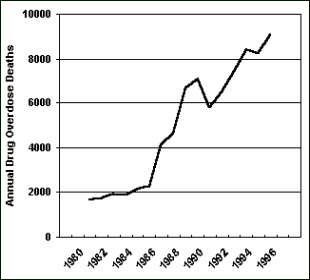
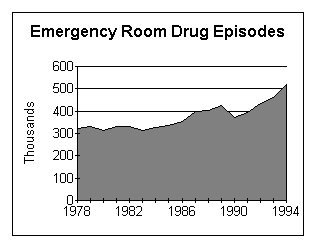
The current model of drug control relies primarily on law enforcement to seize drugs and imprison drug offenders. While these efforts have produced large numbers of arrests, incarcerations and seizures, drug overdose deaths have increased 540% since 1980 and drug-related problems have worsened:1 emergency room visits, adolescent drug use, and the spread of disease (particularly AIDS and hepatitis) have also risen substantially and drug-related crime continues at high levels. In an effort to minimize drug-related crime, illness and death, the Effective National Drug Control Strategy advocates a policy which emphasizes public health approaches to drug control. | |
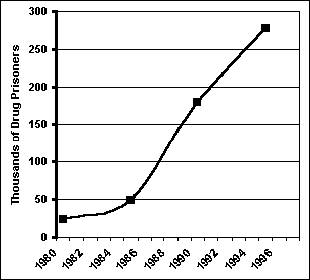
| Incarceration for Drug Arrests | Drug Overdose Deaths |
|---|---|
![]() | ![]() |
How many people must we incarcerate for current drug policy to work? The drug war has succeeded in arresting and incarcerating large numbers of people. There are over 1.7 million Americans behind bars. As of June 1996, 5.5 million Americans were under some form of control by the justice system. This translates into 1 out of every 35 adults in the nation.2 According to the Department of Justice, 85% of the increase in the federal prison population from 1985 to 1995 was due to drug convictions.3 Figure 1 illustrates the massive expansion of drug offenders in the jail and prison population, which has increased nearly 12-fold from 1980 to 1995, and a strikingly similar rise in drug overdose deaths over the same period. The graph cannot express the financial and psychological damage endured by the children and spouses of those incarcerated. Nor does it express the damage that certain communities and racial groups experience. For example, black males born today have a nearly one in three chance of going to prison.4 | |
|
![]() ![]() |
Does the U.S. drug strategy protect children from drugs?
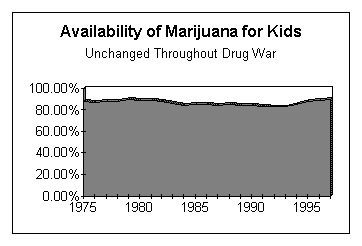
Current government policy seeks to prevent children from gaining access to illegal substances. Since 1975, the federal government has been asking high school seniors how easy it is for them to obtain marijuana. Illustrated by Figure 2 on the left, adolescents' access to marijuana is virtually unchanged by the drug war. In 1975, 87% of youths said it was very easy or fairly easy to obtain marijuana. Twenty-three years and millions of arrests later, 89.6% said it was easily obtained. Has the drug war succeeded in reducing adolescents' access to drugs?
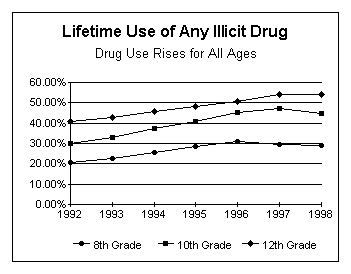
Since 1992, federal surveys show there has been a rise in adolescent drug use. This has coincided with record spending, record arrests and record incarceration rates. The drug war has escalated for decades, but has not resulted in less adolescent drug use. Drug crimes receive some of the most severe criminal sanctions in our legal system. Based on federal surveys and by definition of state and federal law, more than 50% of all high school seniors are drug criminals who should be imprisoned. Is this a realistic or appropriate approach to controlling juvenile drug use? If not, then why should only some be arrested? |
|
How do we determine who gets prison sentences and who does not?
The current model of youth drug control essentially relies on the random chance of arrest, coupled with an increasing use of locker searches, drug-sniffing dogs, and just say no television ads to reduce adolescent drug use. These are unsophisticated approaches to youth drug use that are not based on strategies proven to work. The evidence shows that these strategies have not decreased the availability of drugs for school-aged kids, nor has it deterred their use of drugs. Does the current drug control strategy reduce the supply of drugs and raise their price? | |
![]() Strategy. Table 20. ![]() Strategy. Table 20. ![]() |
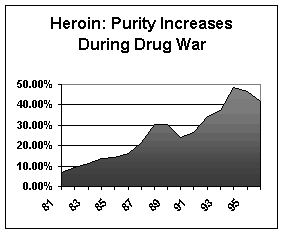
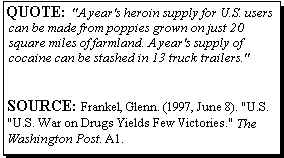
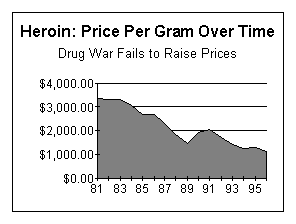
The indicators of a successful supply-reduction effort are rising drug prices and decreasing drug purity levels.5 Using data supplied by the ONDCP (Office of National Drug Control Policy), it is clear that the price of heroin has instead dropped significantly over time, while its production has risen greatly. The price of cocaine has similarly dropped from $275.12 per gram in 1981 to $94.52 in 1996. Despite massive investments in border patrols, overseas crop eradication efforts, Department of Defense involvement and arrests of drug smugglers and drug dealers, the drug war has not reduced the supply of drugs nor made them more costly to obtain. The market prices for illegal drugs follow the same laws of supply and demand that apply to all commodities. The drug war creates an artificially high commodity price, and these huge profit margins have encouraged more drug producers to enter the market. Greater production has created economies of scale. Lower production costs allow drug cartels to earn the same high profit margins with lower retail prices. The cartels accommodate for interdiction efforts by over-producing their commodity to account for the losses. Since a kilogram of raw opium has been reported to sell for $90 in Pakistan, but is worth $290,000 in the United States, law enforcement seizures at our borders have very little impact on cartel operations or profitability.6 Does the current strategy protect public health?Easy availability, increased purity and lowered prices have resulted in high levels of overdose deaths and hospital emergency room drug episodes. Figure 6 illustrates the steady rise in emergency room drug episodes as recorded by the Drug Abuse Warning Network (DAWN). |
|
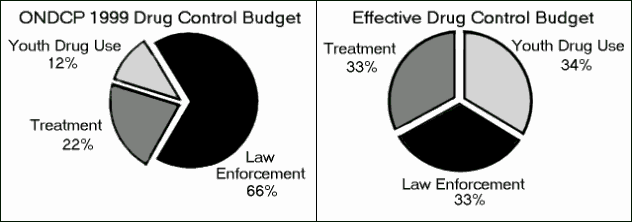
Even more alarming has been the devastating expansion of the HIV and Hepatitis C epidemics due to the prohibition on needle possession. Sharing of needles is an engine for the spread of HIV and Hepatitis C. Each day 33 more people are infected with HIV due to injection drug use.7 The epidemics have been particularly onerous on African-American and Latino communities. By the end of 1997, it was estimated that more than 110,000 African-Americans and 55,000 Latinos were living with injection-related AIDS or had already died from it.8 These facts make it hard to avoid the conclusion that the current model of drug control: 1) does not reduce adolescent drug use; 2) does not reduce the supply of drugs; 3) does not reduce the harm caused by drugs. It is time to develop a drug strategy that works. Since we are failing to reduce the supply and use of drugs, while incarcerating record numbers of drug offenders, we need to accept that criminal laws cannot effectively solve the complex issue of drug use. Indeed, there is mounting evidence that the extreme criminal sanctions we employ today may actually worsen some of the problems of drug abuse. The Effective National Drug Control Strategy provides a detailed alternative model of drug control based on sound research and empirical evidence, and was developed by a wide range of professional associations. The Effective Strategy emphasizes public health approaches, investment in our children and confronting the underlying economic and social problems, which are the root causes of drug abuse. As can be seen from the chart below, the Effective Strategy seeks to balance law enforcement, treatment and prevention efforts. As this strategy takes effect we expect that law enforcement's role in drug enforcement can be reduced further. We urge that five years after implementation, the policy be evaluated and a longer term strategy be developed. | |
| |
| Figure 7 ONDCP National Drug Control Budget vs. The Effective Drug Control Budget. | |
|
1  Drucker, Dr. Ernest. (1998, Jan./Feb.). Public Health Reports, "Drug
Prohibition and Public Health." U.S. Public Health Service. Vol. 114. 2  Bureau of Justice Statistics. (1997, August 14). Nation's probation and parole population reached almost 3.9 million last year. Press Release. Washington, DC: Department of Justice. 3  Bureau of Justice Statistics. Prisoners in 1996. Washington, DC: Department of Justice. 4  Bureau of Justice Statistics. (1997, March). Lifetime Likelihood of Going to State or Federal Prison. p. 1. Washington, DC: Department of Justice. 5  ONDCP. (1998). Performance Measures of Effectiveness. Washington, DC. p. 13. 6  Associated Press. (1997, June 26). "U.N. estimates drug business equal to eight percent of world trade." 7  Day, Dawn. Health Emergency 1999: The Spread of Drug-Related AIDS and Other Deadly Diseases Among African-Americans and Latinos. (1998). The Dogwood Center, p. 5. 8  Day, Dawn. (1998). pp. 1, 4. | |
|
GOAL NUMBER ONE: REDUCE THE HARM CAUSED BY DRUGS IN OUR SOCIETY
OBJECTIVE: FIND A SOLUTION TO DRUG ABUSE THAT REALLY WORKS | |||
|
Recommendation 1: Commission a non-partisan panel of experts to evaluate America's longest war.9 | |||
|
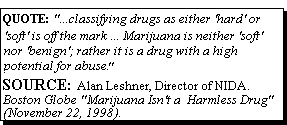
In order to develop a truly effective drug policy, a national commission should be empowered to analyze our approach and recommend new strategies. This commission should be led by an independent commission and all options should be considered for tobacco, alcohol and illegal drugs. ONDCP Director General McCaffrey recently said that legalization is a legitimate cause for debate in a democracy. 11 No doubt we need to consider whether criminal controls relying on police, prosecutors and prisons or legal controls relying on regulation, taxation and administrative law are more effective at controlling drug markets. However, in developing a more effective drug strategy we should remember that the vast majority of immediate policy options are not at the extremes of the debate, but rather involve moderate public health strategies and changes in budget priorities. This document represents a synthesis of centrist approaches to drug control.Recommendation 2: Allow cities and states to experiment with their own approach to drug control. Cities and states have always been important sources of innovation and experimentation in public policy. Closer to their citizenry, city councils and state legislatures are often better qualified to identify solutions to problems which seem impossible at the national level. For instance, the city of Boston has been widely recognized for developing an effective strategy for reducing juvenile crime, and it recently had the distinction of being the only large American city to enjoy no juvenile homicides for more than two years. 12 The program was based on a mixture of community policing and providing at-risk youth with meaningful after-school activities.States and municipalities need greater flexibility from the federal government to address drug abuse as a public health issue. Federal drug policies that encourage states to adopt punitive approaches, including excessive penalties and limits to judicial discretion, are undermining productive state drug policy efforts. Federal drug policy must allow state and local governments the flexibility to develop new rational drug policies that emphasize education, economic opportunity, disease prevention, alternatives to incarceration and access to treatment and rehabilitation services, with some oversight to ensure that individual rights are not harmed in the process. Recommendation 3: Make efforts at all levels of government to separate the markets for marijuana from other illegal drugs. According to a recent report by the World Health Organization (WHO), the hypothesis that adolescent use of hard drugs is a direct effect of marijuana use is the least compelling of all hypotheses. The WHO report suggests that the current prohibition on marijuana may do more to introduce children to hard drugs than any other cause, stating, Exposure to other drugs when purchasing cannabis on the black market increases the opportunity to use other illicit drugs. 13 This finding has important implications for public policy, and suggests that if we want to reduce heroin and cocaine use, we can move closer to that goal by separating the marijuana market from the market for harder drugs. The Netherlands is the only nation which has implemented such a policy, so it is important to note that even though marijuana is widely available, the Netherlands' heroin use rate is 160 users per 100,000 population,14 while the United States is estimated to have 430 heroin users per 100,000 population.15 Thus, when comparing the experience of the two countries, it appears the World Health Organization's hypothesis that the black market in marijuana increases the opportunity to use other drugs has some merit and also reinforces the hypothesis that marijuana can act as a terminus drug, rather than a gateway. The reality is, for every 104 Americans who have used marijuana, there is only one regular user of cocaine, and less than one regular user of heroin.16By promoting an absolutist zero-tolerance policy for all substances regardless of relative dangers and by accepting the 'gateway' myth, we may actually expose those youths and young adults who would briefly experiment with a soft drug like marijuana to more dangerous substances like cocaine and heroin. A public policy that is blind to the reality of drug markets effectively abandons youth who experiment with marijuana the most widely used illicit drug. This is a tragic example of how ideology and adherence to failed policy can prevent our society from making progress in reducing drug use. | |||
| |||
|---|---|---|---|
|
9 On April 16th, 1997, Rep. Cummings (D-MD) with 19 democratic
cosponsors introduced H.R. 1345 a bill to create a Commission on National
Drug Policy. | |||
|
GOAL NUMBER ONE: REDUCE THE HARM CAUSED BY DRUGS IN OUR SOCIETY
OBJECTIVE: REDUCE DRUG ABUSE AND USE AMONG YOUTH AND YOUNG ADULTS
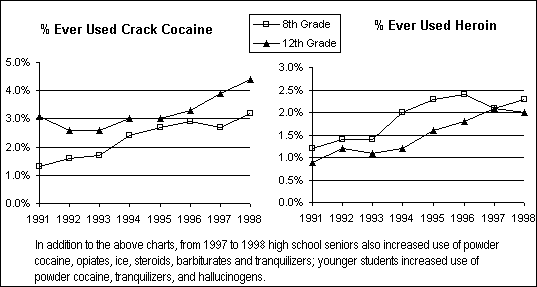
Adolescent drug use has been rising steadily since 1991, which is the longest sustained increase in adolescent drug use since the Monitoring the Future Survey began. After the release of the 1998 Monitoring the Future Survey, 17 the ONDCP issued a surprising press release which stated Second Straight Year of No Significant Increases, Many Categories of Youth Drug Use Fall Significantly. General McCaffrey is quoted as saying, The 1998 Study shows that we have turned the tide of youth drug use.18 Unfortunately, a review of the actual survey data shows a sharply different result.
Survey data indicate that modest declines in the use of the traditionally popular drug
marijuana comprised the major portion of lowered numbers. This decline masked a continuing
rise in hard drug use by our youth. For instance, the percentage of high school seniors
reporting lifetime marijuana use dropped by 0.5%, but the percentage of high school seniors
reporting lifetime crack use increased by 0.5%. Twice as many students reported
using heroin by the 8th grade in 1998 as was reported in 1991. Nearly three times as many
students reported using crack by the 8th grade for the same time period. Exchanging
marijuana use for crack and heroin is clearly not the type of trade-off that most parents
would like to see. The ONDCP's failure to mention any of these significant issues in their
official press statement cheats parents, educators and journalists out of their ability to
understand the dimensions of adolescent drug use. | |
![]() Figure 9 Adolescent use of crack and heroin. Source: 1998 Monitoring the Future Survey, Institute for Social Research, University of Michigan. | |
|
Recommendation 1: TRIPLE the current National Drug Control Strategy budget share for reducing youth and young adult drug use. | |
|
Recommendation 2: Focus funding and efforts on strategies that have documented success in reducing youth drug use.
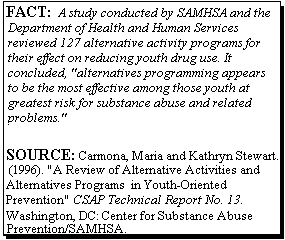
Researchers have noted that adolescence is a period in which youth reject conventionality and traditional authority figures in an effort to establish their own independence drug use may be a 'default' activity engaged in when youth have few or no opportunities to assert their independence in a constructive manner. 22 Moreover, twice as many youths from low-income families are unsupervised for more than three hours per day than youths from high-income families.23 In an independent study of the Big Brother/Big Sister Program, researchers found that Little Brothers and Little Sisters were 46% less likely to start using illegal drugs, and 27% less likely to start drinking. Little Brothers and Little Sisters also did better in school, had better attendance records, and felt slightly better about how they would perform in school.24 Constructive activities and mentoring programs provide a strong environment for youths and young adults to reject all forms of drug use and provide benefits across a wide array of indicators, such as school performance and self-esteem. These kinds of strategies should be central to our efforts to reduce youth and young adult drug use because they actually work.Recommendation 3: Use facts, not scare-tactics to educate youth.
Recommendation 4: Redirect DARE funding into more productive and effective programs.
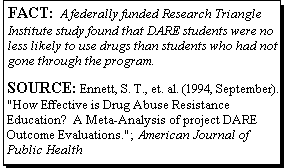
A key aspect of DARE's failure to be effective stems from the program's basic premise the idea that police are appropriate teachers of health information. Police do not teach children about sex education, hygiene or dental care, so why are they teaching children about drugs? It sends the wrong message that drugs are a law enforcement issue, rather than a public health issue. More importantly, a police officer may intimidate adolescents who have experimented with drugs from asking lifesaving questions out of fear that they will get into trouble. In spite of DARE's documented lack of success and its inherent weaknesses, the federal drug education budget provides a 'set aside' for DARE, ensuring that it continues to squander the few prevention dollars this country spends on adolescent drug education. This a failure on the part of our government to protect children from the dangers of drug use and drug abuse. At the very least, DARE should be required to compete with other drug education programs and prove that it can be effective. Furthermore, since federally sponsored studies indicate that nearly 50% of all students try an illegal drug before they graduate from high school, and 85% of students try alcohol, 28 the goal of drug education should be broadened to include reducing the harms related to alcohol and other drug use, as well as preventing adolescent alcohol and other drug use from the outset.Recommendation 5: Be responsible with the provision of anti-drug messages. The ONDCP's newly launched $2 billion advertising campaign to make children aware of the dangers of drug use has been approached in an unscientific and irresponsible way. There is no evidence that advertising is likely to prevent drug abuse, and in fact highlighting drug use may have the reverse effect. In the 1960s, media stories which promoted the dangers of using glue to intoxicate oneself only served to inform children that the common substance could produce a high, and to popularize rather than to discourage the practice. Prior to 1959, glue-sniffing was virtually unknown, but with its publicity, the number of high school students who reported trying it at least once rose to about 1 in 20 by the mid to late 1960s. 30Today, the ONDCP is running a series of advertisements on household inhalants which airs during children's cartoons and while parents are away at work. Just as with the glue-sniffing stories of the 1960s, it is very likely that most young people do not know that inhaling the vapors of everyday household products can produce a high, until they view the advertisements on television. Sending this information into the homes of children without parental consent is irresponsible and has enormous potential for tragedy as children may decide to experiment with the chemicals found under every kitchen sink. According to David Kiley, the Senior Editor of the advertising industry's Brandweek, the research relied upon by the ONDCP, hardly stands up to the slightest breeze of inquiry. In some cases the validity of key parts of the research is even refuted by the people responsible for it. 31 | |
|
17 The Monitoring the Future Survey is an annual survey of drug
use by 8th, 10th, and 12th grade students. | |
|
GOAL NUMBER ONE: REDUCE THE HARM CAUSED BY DRUGS IN OUR SOCIETY
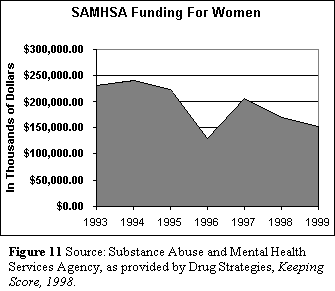
OBJECTIVE: REDUCE DRUG ABUSE AND USE AMONG WOMEN Rationale: Detailed information on women's drug use is limited. Data that examines gender and race-ethnicity and age are rarely published. 32 The 1997 National Household Survey on Drug Abuse found that 34.3% of white women, 19.2% of Latinas, and 24.9% of African-American women reported using an illegal drug in their lifetime. This survey, presents an incomplete assessment of total drug use since it did not include women who were homeless, in colleges and universities, or in institutionalized populations.We do know that drug addiction has increased steadily among girls and women and, in the case of certain drugs, more rapidly than among boys and men. 33 From 1992 to 1997, for example, regular use of cocaine increased for women while men's cocaine use declined slightly.34 Addiction to legally prescribed drugs is also a more serious problem for women than men.35 Emergency room visits by women because of drug-related problems rose 35% between 1990 and 1996.36Women who abuse drugs often face a greater social stigma than men because they fail to fulfill our society's standard for female morality as well as their traditional role as the stabilizing force in the family. 37The extent of drug use among women, the causes of addiction, and its effect on women's lives and bodies are not fully understood because addiction has traditionally been treated as a male disease. 38 However, the problem of drug addiction among women cannot be separated from other aspects of their social conditioning. Studies of women who seek treatment for alcohol and other drug problems have revealed a dramatic connection between domestic violence, childhood abuse, and substance abuse.39 Women substance abusers have high levels of depression, anxiety, and feelings of powerlessness, and low levels of self-esteem and self-confidence.40 Punishing women strips them of control over their lives, exacerbates underlying problems, and fails to provide any strategy for long-term prevention.Policy makers must recognize the connection between drug addiction among women and other health, social and economic problems that women face. The only effective way to address drug abuse is simultaneously to address the problems of violence and sexual abuse, unsafe housing, unemployment, stereotyped sexual roles, lack of health care and lack of child care which contribute to the depression and hopelessness that are underlying causes of substance abuse. The barriers to treatment for women must be addressed. First, only 41% of women who need drug treatment actually receive it. 41 Second, most programs are based on male-oriented models that are not geared to the needs of women. The lack of accommodations for children is one of the most significant obstacles to treatment for women.42 Most clinics do not provide child care and many residential treatment programs do not admit women with children.43Treatment programs have traditionally failed to provide the comprehensive services -- including prenatal and gynecological care, contraceptive counseling, appropriate job training, and counseling for sexual and physical abuse -- that women need. The typical focus on individual pathology may exclude social factors, such as racism, sexism and poverty that are essential to an understanding of drug abuse in women. Recommendation 1: Fund prevention programs that target women. Federal and state governments must increase the amount of funding for prevention efforts that target women and girls about the risks of alcohol and drug use. Prevention strategies and programs must be community-based and sensitive to women's diverse cultural backgrounds and must be developed with significant input from women from local communities. A critical component of a comprehensive national drug prevention strategy for women is widely available needle exchange programs. AIDS is the third leading cause of death among women of reproductive age in the United States, and the number one cause of death for African-American women. 44 In 1997, women accounted for 22% of AIDS cases, compared to seven percent in 1985. Among teenage women ages 13 to 19, the number of cumulative AIDS cases multiplied over 16 times between June 1989 and December 1997; for women ages 20 to 24 the number has multiplied more than nine times. Injection drug use accounted for 28% and 14% of cases in women of these age groups, respectively.45 Women constitute the fastest growing group of new HIV cases in the United States.46Recommendation 2: Increase services for women. | |
|
Congress should mandate increased funding for treatment facilities designed specifically for women. The goal should be universal access to both outpatient and residential treatment services for all women who are addicted to drugs and alcohol. Federal and state guidelines must be established to ensure that programs are geared specifically to the needs of women. Guidelines should be flexible enough, however, to enable local programs to adjust to the particular needs and experiences of the communities they serve. Programs must be designed to overcome the current barriers to women's access to and participation in treatment. The following features are essential to increasing the accessibility of treatment for women:
Recommendation 3: Fund research on women's experiences Congress should increase the amount and proportion of funding devoted to research that explores the particular experience of women who abuse alcohol and other drugs. Federal funding of research projects should be greatly expanded. The research should answer the following questions about women and drug abuse:
This research should not focus solely on the effects of drug use during pregnancy but throughout a woman's life span. All research should be done in the context of delivery of health care and its purpose should be to improve the health of all women. | |
|
32 Drug Strategies. (1998). Keeping Score, 1998: Women and Drugs:
Looking at the Federal Drug Control Budget. Washington, DC: Drug
Strategies. | |
|
GOAL NUMBER ONE: REDUCE THE HARM CAUSED BY DRUGS IN OUR SOCIETY
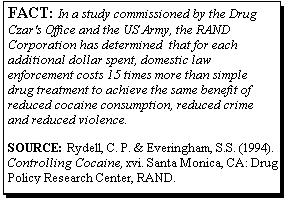
OBJECTIVE: REDUCE DRUG ABUSE AND USE AMONG ALL AMERICANS Rationale: Simple common sense tells us that government spending to reduce alcohol and other drug use should focus on the most effective tactics. Unfortunately, years of politicization and the creation of numerous bureaucracies which derive funding from drug control spending have diverted our drug control budgets away from effective tactics and toward entrenched bureaucratic interests. The ONDCP's 1999 drug control budget is a prime example of the misuse of public money. The RAND Corporation's thorough and scientific examination into the costs and benefits of treatment, interdiction, eradication and prison building has shown that investing additional resources in treatment is the most effective strategy to curtail drug use and abuse, yet the ONDCP's budget still focuses 2/3 of its budget on law enforcement and other ineffective tactics. According to RAND's widely respected study, for each additional dollar spent on cocaine treatment, a social benefit of reduced cocaine consumption, crime and increased productivity valued at $7.46 is received, while each additional dollar spent on eradicating coca overseas represents a loss of eighty-five cents. 48 Amazingly, the Drug Czar's office is requesting $4.6 billion for source-country eradication and interdiction in 1999 (Goals 4 and 5), and plans annual spending increases in these areas over the next four years.49 Total spending on this approach would reach $23 billion between 1999 and 2003. Given the choice of investing one dollar in a bank that will give us 15 cents at year's end or one that will give us over 7 dollars, the government has opted for the 15 cents. By continuing this waste, the government is failing to help those in need of treatment and failing to reduce the consumption of drugs in our communities.Recommendation 1: Provide drug treatment upon request and a variety of treatment options.
The provision for treatment upon request has been Federal law since 1988. Section 2012 of the Anti-Drug Abuse Act of 1988 sets out the purpose of the law, which is: To increase to the greatest extent possible the availability and quality of treatment services so that treatment on request may be provided to all individuals desiring to rid themselves of their substance abuse problem.50 Yet, the 1998 National Drug Control Strategy, which provides a 10-year plan for US national drug strategy, makes no provision for making treatment-on-request a reality. The President, the Congress, researchers and drug abuse professionals all agree treatment on request should be made available, yet the ONDCP has not even mentioned it as a goal. Furthermore, treatment options need to be expanded to address the variety of needs persons with drug problems have. Some people will respond quite readily to abstinence-based programs like Narcotics Anonymous and Alcoholics Anonymous. Others will require methadone therapy to stave off the symptoms of opiate addiction, or a gradual weaning from their addiction through doctor-supervised maintenance programs. For more specific recommendations of treatment options, please see the section entitled, Allow Doctors Greater Freedom to Address Public Health Issues. Recommendation 2: Enact legislation that provides full continuum insurance coverage for substance abuse treatment. If our society is truly serious about reducing drug use, then we must make every effort to move those people who wish to be treated for drug addiction into treatment facilities. One of the most effective means to do so is to provide full continuum insurance for substance abuse. As stated in a report commissioned by the Connecticut State Legislature, this would include screening, assessment, intervention, detoxification, short-term and long-term inpatient rehabilitation, outpatient and intensive outpatient services, family treatment, and methadone maintenance treatment. 51 This was also the goal of legislation introduced in the 105th Congress.52 By providing addiction treatment through medical insurance, we reduce the need for people to rely on public funding and facilities to treat substance abuse problems.Recommendation 3: Reduce children's exposure to cigarette and alcohol advertising. One of the main goals of advertising is to create demand for a product, industry or idea. As two of the largest sources of illness and death in America, it is not beneficial to glamorize or promote cigarettes and alcohol to young children. An effective drug control strategy would examine ways to reduce children's exposure to such marketing, perhaps by limiting alcohol ads to television programs which are rated for adult content. The marketing of addictive products to children must be addressed, while balancing the commercial speech rights of legal businesses to market their products or educate the public on policy issues related to their industry. | |
|
48 Rydell & Everingham. Controlling Cocaine: Supply Versus
Demand Programs, RAND Corporation (Santa Monica, CA: 1994), p.
xvi). | |
|
GOAL NUMBER ONE: REDUCE THE HARM CAUSED BY DRUGS IN OUR SOCIETY
OBJECTIVE: REDUCE THE SPREAD OF INFECTIOUS DISEASE
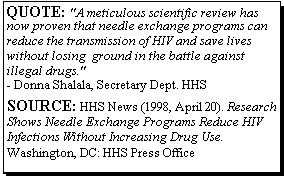
Recommendation 1: Repeal all State and Federal laws designed to prevent access to and possession of sterile syringes and injection equipment.53 Needle exchange programs are one of the most effective means of stemming the devastating and costly tide of AIDS and Hepatitis in our communities. Each day, 33 Americans 54 become newly infected with HIV, and 50% of these cases are due to the sharing of contaminated needles. 55 Women and children are even more severely impacted by needle contamination. Ninety (90%) percent of all new AIDS cases in women and in children under 13 for which the exposure group is known are injection related. 56 Each person living with AIDS will need approximately $195,000 in treatment over their lifetime and can potentially infect thousands of other individuals; meanwhile, a clean syringe only costs about eight cents. These needless deaths and costs can be avoided through the use and promotion of needle exchange programs and provision of syringes in pharmacies. Laws which exist to limit the supply of clean needles, simply ensure the proliferation of contaminated needles.
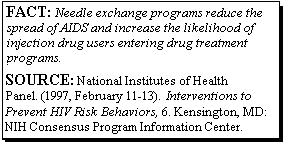
Equally important, the National Institutes of Health have concluded that individuals in areas with needle exchange programs have an increased likelihood of entering drug treatment programs.59 Thus, needle exchange programs reduce AIDS and work toward reducing drug abuse. Recommendation 2: Make prevention and treatment of Hepatitis-C a high public health priority. Just as with the emergence of HIV, which was spread in part by the sharing of needles, a newly recognized strain of Hepatitis, known as Hepatitis-C Virus (HCV) is rapidly emerging as a major blood-borne disease. According to the Centers for Disease Control and Prevention, HCV infection is a major cause of chronic liver disease in the United States and worldwide. At least 85% of persons with HCV infection become chronically infected and chronic liver disease with persistently elevated enzymes develops in approximately 70% of all HCV infected persons. 60 Unlike the inexpensive intervention of decriminalizing needle possession, the CDC says the estimated cost for each [infected] person for a 6-month course of therapy is $200,000.61 In 1998, it was estimated that approximately 4,000,000 Americans were infected with Hepatitis-C. The cost and devastation that will be caused by this epidemic can be greatly reduced through a strong and effective education campaign, combined with outreach to at-risk populations and access to sterile syringes. There is also a need for drug users to have access to medical care, accurate information about the possibility of disease progression once infected, an all out effort for a cure and for drug users to be included in developing new therapeutic interventions. | |
![]() | |
|---|---|
|
53 H.R. 2212, HIV Prevention Outreach Act, was introduced by
Rep. Cummings (D-MD) with 7 co-sponsors on July 22nd, 1997. This bill would
have required the Secretary of Healthand Human Services to make grants to
"States and political subdivisions of States" for needle exchange
programs. | |
|
GOAL NUMBER ONE: REDUCE THE HARM CAUSED BY DRUGS IN OUR SOCIETY
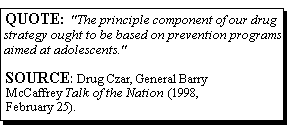
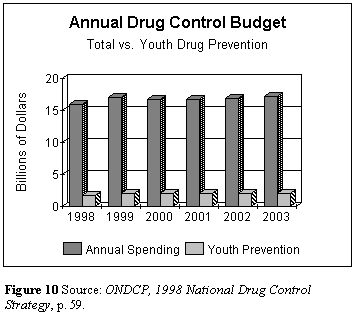
CHAPTER SUMMARY We need to reduce the harm that drug use and abuse cause in our society. This requires that we find solutions to drug abuse that really work. Some important strategies to consider include forming a commission of non-partisan experts to evaluate the effects of the current drug control model and allowing cities and states greater flexibility to experiment with their own approaches to drug control. It is also important that drug policy not be based on clearly erroneous concepts like the 'gateway' theory which have been rejected by prestigious groups such as the World Health Organization. Separating the markets for marijuana and other illegal drugs may also be a wise approach because research shows that it is the black market which introduces youth to more harmful substances. Reducing drug use and abuse among youth and young adults is another important goal in reducing the harm caused by drugs. An effective drug control strategy would implement Drug Czar Barry McCaffrey's assertion that The principal component of our drug strategy ought to be based on prevention programs aimed at adolescents. 62 Making this the principal component requires that it receive a principal share of the funding. To carry out this goal, we need to do two things: raise the spending on youth prevention from its current paltry level of 12% of the drug control budget to 34% and spend that 34% of the budget on programs that actually work as demonstrated by science and research. Investments in our youth, such as after school programs, Big Brother/Big Sister programs, and other enrichment activities are effective and the Federal government's research as published by SAMHSA confirms this. Meanwhile, programs like DARE, television ads and other scare-tactics have not been proven effective at reducing drug use. Funding for programs should be competitive and based on results, not politics.We must also seek to reduce drug use and abuse in all age groups and in all sectors of society, with special emphasis on the needs of women. Since treatment has been shown to be the most effective tool to reduce drug consumption in this country, it should be a serious component of our national drug control strategy. Instead of putting 2/3 of our funding into law enforcement measures, we should fully fund treatment centers so that treatment is available upon request, and enact legislation that provides full-continuum insurance coverage for drug and alcohol addiction. In the struggle against the harms of drug and alcohol addiction, the lack of treatment availability in the United States virtually ensures that we will continue to suffer horrendous social costs from these diseases. Finally, we must stop the spread of diseases associated with injection drug use. With the high number of new HIV and hepatitis infections, laws against the possession of clean needles are a virtual death sentence. Needle exchange programs do not increase drug use, but do save lives. A ban on federal funding for needle exchange programs is pure folly. Claims that decriminalizing needle possession will lead to increased drug use have been never been proven. Seven reports funded by the U.S. Government between 1991 and 1997 are unanimous in their conclusions that clean needle programs reduce HIV transmission, and none find that clean needle programs cause rates of drug use to increase. 63 | |
|
62 ONDCP Director | |
|
GOAL NUMBER TWO: REDUCE THE HARM CAUSED BY THE "WAR ON DRUGS"
OBJECTIVE: REDUCE CRIME AND VIOLENCE ASSOCIATED WITH THE DRUG WAR. | |
|
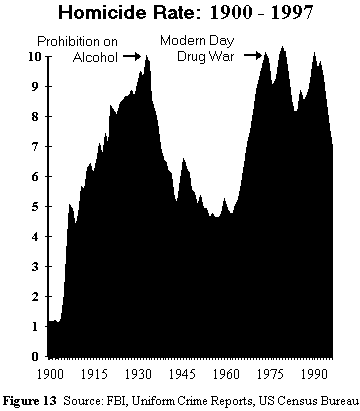
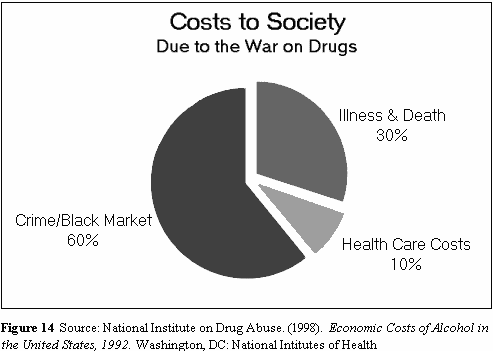
As reported in the Journal of the American Medical Association, the nationwide emphasis on arresting drug dealers may have produced a labor shortage, which contributed to the high mortality rate of the 1980s. Every time you jail a drug dealer, you open up a new opportunity for an enterprising young man. What does he do to compete for this job? He kills for it. 65 The chart shown above illustrates the homicide rate in the United States for the 20th Century. Note that this century's two most violent episodes are concurrent with stringent prohibition policies.In a 1998 study on the social costs of alcohol and illegal drugs produced by the National Institute on Drug Abuse (NIDA), researchers estimated that illegal drugs cost our society $98 billion in 1992 (the most recent year that statistics were available). Approximately 60% of societal drug costs were due to drug-related crime and the black market. These included police, legal and incarceration costs, lost productivity of incarcerated criminals and victims of crimes, as well as the lost productivity due to drug-related crime careers. In fact, the researchers said that the rising societal costs of drug use can be explained by the emergence of the cocaine and HIV epidemics, an eight-fold increase in State and Federal incarcerations for drug arrests and about a three-fold increase in crimes attributed to drugs. Less than 30% of the costs were due to the actual biological effects of drug use that is, drug-related illness or death. Moreover, this number probably includes a number of prohibition-related costs as well, since the prohibition on needle possession is a leading factor in the spread of HIV and Hepatitis C. This contrasts sharply with alcohol, where 2/3 of the costs were directly due to alcohol related illness and death. Overall, this study and figure illustrated below show that our failing War on Drugs actually creates the majority of costs our communities pay when considering illegal drugs.
![]() In light of these facts, the researchers did not call for a new offensive in the War on Drugs, new resources for the police, or new laws to put people in jail for longer sentences. Instead, NIDA director Dr. Alan Leshner said, The rising costs from these and other drug-related public health issues warrant a strong, consistent and continuous investment in research on prevention and treatment. From these facts, we know that the War on Drugs has created violence, addiction, and crime where once there was only addiction. Today, the cost of drug-related crime and violence actually exceeds the cost of drug use itself. This cycle could be broken by providing sufficient resources for treatment. Simply put, the policy of waging war on the sick and addicted has failed, while treatment and prevention are still waiting to be implemented in any meaningful way. Recommendation 1: Commission a study on the relationship between drugs, alcohol and violence.
Currently, many policy makers operate under the assumption that drug use causes violence. If this is the case, it needs to be documented and understood, and not just assumed. On the other hand, many public health and criminal justice experts feel that most drug-related violence is actually a by-product of a black market and the types of people who engage in narcotics trafficking. According to members of the Panel on the Understanding and Control of Violent Behavior for the National Academy of Sciences, Most of the violence associated with cocaine and narcotic drugs results from the business of supplying, dealing and acquiring these substances, not from the direct neurobiologic actions of these drugs.67 Policy makers must focus their efforts on reducing the violence associated with the drug trade, not simply locking up non-violent offenders to increase arrest statistics. | |
|
64 Goldstein, Paul, J., Henry H. Brownstein, Patrick J. Ryan and
Patricia A. Bellucci. (1989 Winter). "Crack and Homicide in New York City: A
Conceptually Based Event Analysis." Contemporary Drug Problems.
16(4):651-687. | |
|
GOAL NUMBER TWO: REDUCE THE HARM CAUSED BY THE "WAR ON DRUGS"
OBJECTIVE: MAKE CRIMINAL PENALTIES FIT THE SEVERITY OF THE CRIME | |
|
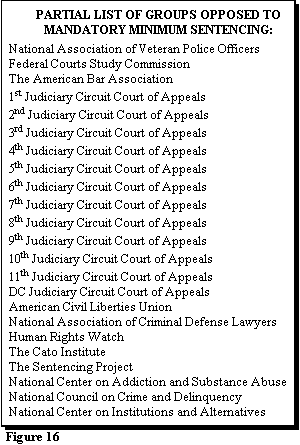
The combination of stringent guidelines and mandatory sentencing along with similar harsh sentencing penalties adopted by most states has produced a burgeoning rate of incarceration in the United States. Prisons should be a solution of last resort. Addiction is a disease, and no disease, whether it is cancer or addiction, is effectively treated by incarceration. Moreover, our nation's addiction to prison building has contributed to declines in education spending in many states and undermines the global competitiveness of our country. Recommendation 1: End mandatory minimum sentencing (statutory and guideline). 70Although few anticipated the outcome when these laws were being drafted, mandatory minimum sentencing has had an extremely negative impact on American society and has failed to meet its objectives. It is time to restore the traditional authority of judges to determine sentences on a case-by-case basis, so that punishments fit the crime. Consider the following facts:
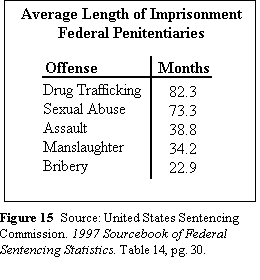
Combined, these facts tell us that mandatory minimum sentencing has forced us to build many new prisons to house low-level and non-violent offenders for extremely long periods of time. According to the Federal Bureau of Prisons, the sentence for the average drug offender is 2.5 times that of the average assault sentence. Ironically, even building new prisons to hold drug offenders for an average of 82.3 months does not provide enough prison space because new prisons are being built all the time. Considering the fact that 24 million Americans used illegal drugs in the past year, it is hard to see how increased incarceration has done anything to stop drug use in America.75 Moreover, the Department of Justice has acknowledged that, the amount of time inmates serve in prison does not increase or decrease the likelihood of recidivism.76
Unfortunately, mandatory minimum sentencing has been largely a failure at apprehending and
holding high-level drug
dealers.77
By removing a judge's discretion from considering the actions
of a drug defendant during the sentencing phase of a case, prosecutors have been handed
incredible power.
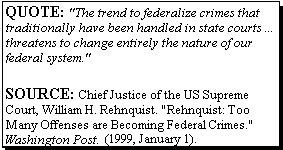
Recommendation 2: Alter sentencing guidelines so judges have more room to maneuver within Guideline boxes and make the Guidelines advisory, rather than mandatory. Guidelines should also encourage greater reliance on role in the offense as a factor that mitigates or aggravates a sentence. As a result of mandatory sentencing guidelines, judges have too little discretion. By implementing the above recommendation, judges will benefit from the guidance of knowing what is expected in an ordinary case, but they will not be confined too tightly in unusual cases. Reducing the stakes of the calculation will also relieve other problems like 'charge bargaining' and congested appeals because more appropriate sentences will be passed. If our legal system can distinguish between different types of homicide defendants, then at the very least, drug defendants should be accorded the same consideration. Recommendation 3: Allow judges to determine whether a drug prosecution is handled more appropriately by state, local or federal courts.
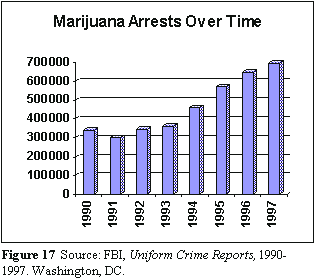
Recommendation 4: Cease the costly and ineffective targeting of marijuana possession cases. The most recent FBI Uniform Crime Reports indicate that there were 695,201 marijuana arrests in 1997, which is about a 100% increase since 1991. Eighty-seven percent (87%) of these arrests were simply for possession of marijuana. Since the vast majority of arrests are for possession, there is clear evidence that these cases consume a disproportionate share of law enforcement resources that could otherwise be devoted to fighting property and violent crimes. According to the same FBI data, nearly as many people were arrested for marijuana offenses as were arrested for murder, rape, robbery, and aggravated assault combined.
| |
|
68 The Comprehensive Crime Control Act of 1984. (1984). Pub. L. No.
98-473, 8 Stat. 1937. | |
|
GOAL NUMBER TWO: REDUCE THE HARM CAUSED BY THE "WAR ON DRUGS"
OBJECTIVE: END THE RACIAL BIAS IN DRUG LAWS
Recommendation 1: End the disparity between crack and powder cocaine sentencing. 83The sentencing disparity between crack and powder cocaine has wreaked havoc on minority communities. First, the powder form of cocaine that is preferred by wealthier, usually white consumers, requires 100 times as much weight to trigger the same penalty as the crack form. These stiff penalties apply to the mere possession of crack, unlike any other drug which requires an intent to distribute.84 As an initial step to address this blatant inequity, the penalties for these two forms of the same drug should be harmonized at the current levels for powder cocaine.
| |
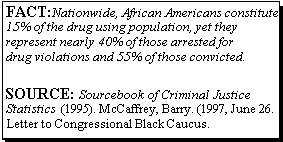
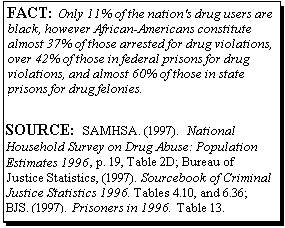
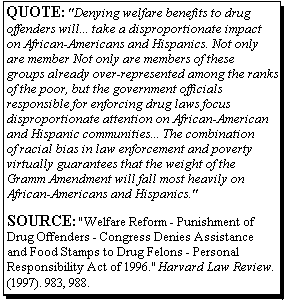
In 1986, before mandatory minimums instituted the crack/powder sentencing disparity, the average sentence for blacks was 6% longer than the average sentence for whites. Four years later following the implementation of this law, the average sentence was 93% higher for blacks. 85 Furthermore, this overly harsh approach encourages drug dealers to enlist young children in their trade in an effort to escape prosecution. The chart above illustrates how blacks and Latinos have been imprisoned disproportionately when compared to other racial groups.Today, one in four black men can expect to be incarcerated in his lifetime. 86This widespread incarceration of black males has increased the burdens on the African-American family unit and the entire community. Our drug laws should not fall disproportionately on one ethnic group. This disparity undermines efforts to stabilize communities and reduce the impact of drug use and abuse.Recommendation 2: Stop targeting black and Latino communities for needle possession arrests. The policy of denying sterile needles to persons who inject drugs arose a number of years ago, in the pre-HIV/AIDS era. No research has ever shown that making needle possession illegal was effective in reducing drug consumption. But it was effective at making sterile needles scarce and in encouraging persons who injected drugs to share their needles and thus their blood-borne diseases. |
Figure 18 The figure above illustrates that Blacks and Hispanics use less drugs, yet have significantly higher rates of incarceration than whites. Sources: SAMHSA: National Household Survey on Drug Abuse: Population Estimates 1997; Bureau of Justice Statistics (1998). Sourcebook of Criminal Justice Statistics 1997; *Estimates for Hispanics do not include the number of Hispanic men and women in local jails. Data on Hispanic incarceration provided by Bureau of Justice Statistics, (1997). |
|
With the arrival of HIV/AIDS, we had an ineffective policy of drug control (criminalization of sterile needle possession) become a major factor in the spread of a deadly epidemic. In states where mere possession of a syringe is a crime, the person who carries his or her own safe needles risks arrest at all times. Race is a factor in the problem of inadequate access to clean needles because black and Latino communities have been particularly targeted for drug enforcement efforts. In 1994, there were 166,000 arrests for possession of heroin and cocaine among whites and 153,000 arrests for possession of heroin and cocaine among blacks. Among people who inject drugs, African-Americans are four times as likely as whites to be arrested for possession of heroin and cocaine. 87Since possession arrests for blacks and Latinos are higher, this means that police are more likely to confiscate the personal needles of non-whites. And because the non-white users know (correctly) that they are vulnerable to arrest, the black and Latino drug users are likely to voluntarily get rid of their own clean needles to avoid arrest. The end result of these types of policies, is that black and Latino people are nearly five times as likely to contract injection-related HIV, than to die from a drug overdose. Making needles scarce doesn't stop drug use, it simply spreads AIDS. The black and Latino communities are suffering greatly from this counter-productive policy.88 | |
|
82 H.R. 118, Traffic Stops Statistics Act of 1997, was
introduced by Rep. Conyers (D-MI) on January 7th, 1998. | |
|
GOAL NUMBER TWO: REDUCE THE HARM CAUSED BY THE "WAR ON DRUGS"
OBJECTIVE: DO NOT UNDERMINE EDUCATION IN THE NAME OF THE "WAR ON DRUGS" | |
|
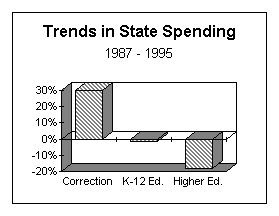
Rationale: Our nation's continued reliance on increasing penalties for non-violent crimes has led to a prison building expansion so costly that it has forced states to curtail important investments in other areas. Most notably, the education of our youth has been significantly cut, in order to pay for prison building and incarcerating citizens. The figure shown at right graphically illustrates the dramatic changes in spending that have taken place at the state level from 1987 to 1995, showing that the United States has chosen to build prisons by cutting investments in education at all levels. Recommendation 1: State governments should not spend more on prisons than on education. |
|
|
Our national investment in prisons has placed a great obstacle on our ability to educate our children. Throughout the 1990's, college tuition continues to rise faster than inflation. 89 States continue to | |