
OBJECTIVE: REDUCE CRIME AND VIOLENCE ASSOCIATED WITH THE DRUG WAR.
 Rationale:
Violence itself can be successfully dealt with as a public health problem. It is important to
consider the fact that most “drug-related” violence is actually drug trade
related. In an analysis of New York City's homicides in 1988, Paul Goldstein and his
colleagues concluded that 74 percent of drug-related homicides were related to the black
market drug trade and not drug use. For instance, the leading crack-related homicide cause
was shown to be territorial disputes between rival dealers, and not crack-induced violence or
violence (predatory thieving) to obtain money for crack
purchases.
Rationale:
Violence itself can be successfully dealt with as a public health problem. It is important to
consider the fact that most “drug-related” violence is actually drug trade
related. In an analysis of New York City's homicides in 1988, Paul Goldstein and his
colleagues concluded that 74 percent of drug-related homicides were related to the black
market drug trade and not drug use. For instance, the leading crack-related homicide cause
was shown to be territorial disputes between rival dealers, and not crack-induced violence or
violence (predatory thieving) to obtain money for crack
purchases.
As reported in the Journal of the American Medical Association, the nationwide emphasis on arresting drug dealers may have produced a labor shortage, which contributed to the high mortality rate of the 1980s. “Every time you jail a drug dealer, you open up a new opportunity for an enterprising young man. What does he do to compete for this job? He kills for it.”
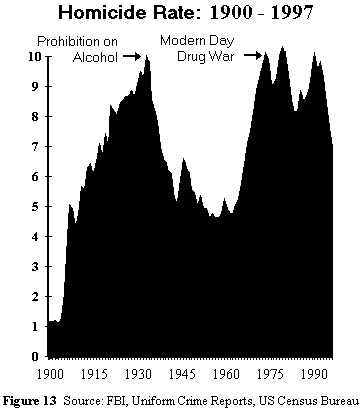
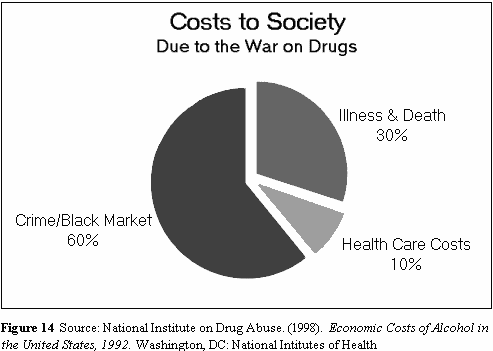
65 The chart shown above illustrates the homicide rate in the United States for the 20th Century. Note that this century's two most violent episodes are concurrent with stringent prohibition policies.In a 1998 study on the social costs of alcohol and illegal drugs produced by the National Institute on Drug Abuse (NIDA), researchers estimated that illegal drugs cost our society $98 billion in 1992 (the most recent year that statistics were available).
Approximately 60% of societal drug costs were due to drug-related crime and the black market. These included police, legal and incarceration costs, lost productivity of incarcerated criminals and victims of crimes, as well as the lost productivity due to drug-related crime careers. In fact, the researchers said that the rising societal costs of drug use “can be explained by the emergence of the cocaine and HIV epidemics, an eight-fold increase in State and Federal incarcerations for drug arrests and about a three-fold increase in crimes attributed to drugs.” Less than 30% of the costs were due to the actual biological effects of drug use – that is, drug-related illness or death. Moreover, this number probably includes a number of prohibition-related costs as well, since the prohibition on needle possession is a leading factor in the spread of HIV and Hepatitis C. This contrasts sharply with alcohol, where 2/3 of the costs were directly due to alcohol related illness and death. Overall, this study and figure illustrated below show that our failing War on Drugs actually creates the majority of costs our communities pay when considering illegal drugs.
In light of these facts, the researchers did not call for a new offensive in the War on Drugs, new resources for the police, or new laws to put people in jail for longer sentences. Instead, NIDA director Dr. Alan Leshner said, “The rising costs from these and other drug-related public health issues warrant a strong, consistent and continuous investment in research on prevention and treatment.” From these facts, we know that the War on Drugs has created violence, addiction, and crime where once there was only addiction. Today, the cost of drug-related crime and violence actually exceeds the cost of drug use itself. This cycle could be broken by providing sufficient resources for treatment. Simply put, the policy of waging war on the sick and addicted has failed, while treatment and prevention are still waiting to be implemented in any meaningful way.
Recommendation 1: Commission a study on the relationship between drugs, alcohol and violence.
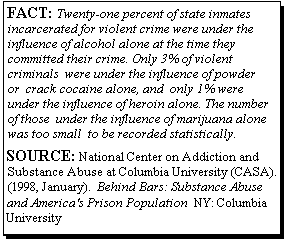 A recent study by the National Center on Addiction and Substance Abuse at Columbia University
(CASA), entitled Behind Bars: Substance Abuse and America's Prison Population,
indicates that only 3% of violent criminals in state prisons were under the influence of
crack or powder cocaine at the time their crime was committed, and only 1% were under the
influence of heroin. In jails, none of the violent criminals was under the influence
of heroin at the time their crime was committed. These facts indicate that our policy makers
need to become more sophisticated in their approach to crime and violence, if we are ever to
see a meaningful reduction in these social ills.
A recent study by the National Center on Addiction and Substance Abuse at Columbia University
(CASA), entitled Behind Bars: Substance Abuse and America's Prison Population,
indicates that only 3% of violent criminals in state prisons were under the influence of
crack or powder cocaine at the time their crime was committed, and only 1% were under the
influence of heroin. In jails, none of the violent criminals was under the influence
of heroin at the time their crime was committed. These facts indicate that our policy makers
need to become more sophisticated in their approach to crime and violence, if we are ever to
see a meaningful reduction in these social ills.
Currently, many policy makers operate under the assumption that drug use causes violence. If this is the case, it needs to be documented and understood, and not just assumed. On the other hand, many public health and criminal justice experts feel that most “drug-related” violence is actually a by-product of a black market and the types of people who engage in narcotics trafficking. According to members of the Panel on the Understanding and Control of Violent Behavior for the National Academy of Sciences, “Most of the violence associated with cocaine and narcotic drugs results from the business of supplying, dealing and acquiring these substances, not from the direct neurobiologic actions of these drugs.”67 Policy makers must focus their efforts on reducing the violence associated with the drug trade, not simply locking up non-violent offenders to increase arrest statistics.
64 Goldstein, Paul, J., Henry H. Brownstein, Patrick J. Ryan and
Patricia A. Bellucci. (1989 Winter). "Crack and Homicide in New York City: A
Conceptually Based Event Analysis." Contemporary Drug Problems.
16(4):651-687.
65 Cole, Thomas B. (1996 March 6). "Authorities Address US Drug-Related
`Arms Race.'" Journal of American Medical Association. Vol. 275, No. 9.
American Medical Association.
66 Dr. Alan Leshner, as quoted in NIDA press release "Economic Costs of
Alcohol and Drug Abuse Estimated at $246 billion in the United States." (1998,
May 13).
67 Miczek, Klaus A., Joseph F. DeBold, Margaret Haney, Jennifer Tidey,
Jeffery Vivian, and Elise M. Weerts. (1994). "Alcohol, Drugs of Abuse,
Aggression and Violence." In Understanding and Preventing Violence: Social
Influences. Vol. 3. Albert J. Reiss, Jr. and Jeffery Roth, eds. Washington,
DC: National Academy Press.