
OBJECTIVE: ALLOW DOCTORS & PATIENTS GREATER FREEDOM IN HEALTH DECISION MAKING TO MEET INDIVIDUAL NEEDS
Rationale: No policy to control drug use should be implemented at the expense of the sick, elderly and dying, and no person should be denied access to a potentially beneficial medication because someone else might use it improperly. Pain management and disease control should be based on respect for individual rights and science, not politics.
Recommendation 1: Transfer scheduling authority to the Department of Health and Human Services.
The Controlled Substance Act of 1970 created five schedules (or categories) for various drugs. The authority to schedule a drug resides with the Drug Enforcement Administration. As a result, scheduling decisions are dominated by law enforcement interests rather than public health concerns. In order to give public health issues the proper role in the scheduling of drugs, this authority should be transferred to the Department of Health and Human Services, the only agency whose mandate is to manage public health issues.
| Partial List of Organizations Supporting Physicians Right to Recommend or Discuss Marijuana Therapy With Patients |
|---|
|
American Medical Association (1997) American Society of Addiction Medicine (1997) Bay Area Physicians for Human Rights (1997) Alive: People With HIV/AIDS Action Committee (1997) California Academy of Family Physicians (1997) California Medical Association (1997) Gay and Lesbian Medical Association (1997) Medical Association (1997) Multiple Sclerosis California Action Network (1996) Francisco Medical Society (1997) Figure 20 |
In one of the most dramatic success stories in modern addiction treatment, doctors in Switzerland have discovered that the provision of medically determined doses of heroin to heroin addicts significantly improves their health, lifestyle and reduces the amount of crime associated with drug use when they are permitted to leave the black market environment. The Swiss researchers concluded that:
The success of this program illustrates how deeply our current policies are failing to reduce most of the consequences of drug use in this country. In light of that failure, our country must be able to learn from the successes of other nations and experiment with techniques that might improve living conditions for everyone.
Recommendation 3: Allow doctors greater freedom in prescribing medications for pain control.97
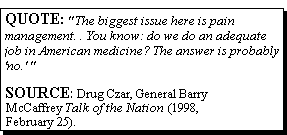 As stated by ONDCP Director Barry McCaffrey, we are not doing enough to help the millions of Americans who suffer from chronic pain. The restrictions for prescribing Schedule 2 drugs like morphine are so strong, and the penalties so great, that doctors consistently under-prescribe pain medication to those who need it most. In 1998, Rep. Henry Hyde introduced the Lethal Drug Abuse Act of 1998, which would have given the Drug Enforcement Administration the power to revoke the prescription license of any doctor who intentionally prescribes a lethal dose of pain medication to a patient. Such a law can only have a chilling effect on the type of pain alleviation doctors will be willing to provide. Giving greater freedom to doctors will allow them to prescribe drugs that work to those in need.
Recommendation 4: Allow a broader distribution of opiate agonist chemotherapy (e.g. methadone, LAAM) and move oversight of such programs to the Center for Substance Abuse and Treatment.
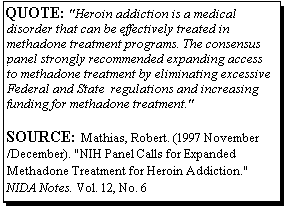 Methadone is the safest, most effective and least costly method to treat heroin addiction, yet it remains a strictly controlled method of treatment. For every 10 heroin addicts in America, there are only one or two methadone treatment slots. We must expand opiate agonist treatment facilities so that every heroin addict can obtain treatment on demand.
Opiate agonist treatment and particularly methadone maintenance has many additional benefits, such as the reduction of criminal behavior. Studies show that arrests decline as patients no longer need to finance a costly heroin addiction. Methadone is a medication that stabilizes a dysfunctional neurological condition and produces no euphoric effects.98 Methadone allows patients to stabilize their lives, restore relationships with their families, return to legitimate employment and contribute to their community as any other individual. In order to meet the need for opiate agonist treatment, doctors must be permitted to prescribe methadone and other pharmacotherapies like any other prescription drug. Opiate agonist treatment should also be administered in the prison systems and through a variety of delivery systems to give opiate addicts easy access to treatment. Opiate agonist treatment should be a valid medical procedure for public and private insurance and not limited to one treatment experience. Opiate addiction is a chronic relapsing medical condition and coverage for treatment should reflect this. Incarcerated opiate addicts and methadone patients who need to be withdrawn should receive adequate medical care; the only approved medication for opiate withdrawal is methadone.
However, since the medical condition of addiction is misunderstood, we recommend that some form of oversight be undertaken to protect patients from physicians who may decide they no longer want to treat them. Pain patients can also face a similar situation for a variety of reasons, such as when a clinician is afraid of DEA interference.
The oversight of methadone maintenance programs should be transferred from the Food and Drug Administration to the Center for Substance Abuse and Treatment (CSAT). CSAT's oversight should include the concepts of a new accreditation system that will be based on reduced regulations, treatment outcome and quality treatment. We urge that state regulatory agencies and programs review their policies which have been based on the dysfunctional patient rather than the stable patient to reflect this new accreditation system.
It is imperative that methadone patients and others participating in opiate agonist treatment be included in all levels of policy making with regard to treatment. Methadone patients have been excluded from policy decisions for too long. Finally the government should undertake a public relations campaign to destigmatize the users of illicit drugs and create a more caring environment for those desiring recovery.
Recommendation 5: Recognize the rights of states, doctors and patients to make their own decisions regarding the usefulness of medical marijuana.99
Cancer and AIDS are horrific diseases that require inordinate amounts of strength and energy to overcome. In many cases, the harsh treatments required to combat the diseases kill patients long before the diseases ever do. A pervasive side-effect of treatment is intense nausea which prevents patients from obtaining the nourishment they need to fight the disease and endure treatment.
The medical efficacy of marijuana in combating this particular type of nausea has been so well documented that the federal government and pharmaceutical companies have developed a synthetic form of marijuana's active ingredient, THC. However, the manufactured drug is not as effective in many cases because marijuana contains many other useful compounds that are not provided by synthetic THC, and nausea makes it difficult for patients to ingest pills.
Over 90 published reports have documented that marijuana has medical value in controlling nausea, stimulating appetite, controlling muscle spasms and preventing blindness from glaucoma. In recognition of the efficacy of medical marijuana, the New England Journal of Medicine, the American Bar Association, and the American Public Health Association (among dozens of others) have all endorsed medical access to marijuana. The DEA's Chief Administrative Law Judge, Francis L. Young has ruled: “Marijuana, in its natural form, is one of the safest therapeutically active substances known. [The] provisions of the [Controlled Substances] Act permit and require the transfer of marijuana from Schedule I to Schedule II. It would be unreasonable, arbitrary and capricious for the DEA to continue to stand between those sufferers and the benefits of this substance.”
100 In America today, patients face penalties of up to one year in prison for the possession of a single dose of this medication.101 This approach to medical marijuana must be changed immediately, and seriously ill patients should never be punished for obtaining or using any drug with the earnest intent of treating their illness, provided that their activities are not directly threatening the safety or well-being of others.Recommendation 6: End the de facto moratorium on medical marijuana research.
Now that voters in states representing one-fifth the US population have voted for medical marijuana, the federal government needs to take urgent action to resolve the medical marijuana debate. The votes in the states, as well as other state laws, provide the Food and Drug Administration with an opportunity to research medical marijuana on a large number of people. When research stopped FDA research on the drug was in the final phase before market approval. Funding should be provided to take the final research steps necessary to make marijuana available by prescription. Many organizations, such as the American Medical Association, the American Cancer Society, and the National Academy of Sciences support unimpeded research of medical marijuana. When it comes to medicine, we should be doing everything we can to help those who suffer from a serious illness, not outlawing important areas of research.
Recommendation 7: Develop a distribution system for medical marijuana.
The current total ban on the use and distribution of medical marijuana forces thousands of critically ill patients to purchase their medication in dangerous black markets, where they are at risk of abuse by drug dealers. In order to prevent further harm to medical patients, and in light of the overwhelming public support for medical marijuana in every state that has had a vote on the issue, the federal government should develop a system of distribution for medical marijuana so that this medicine reaches patients in a safe and effective manner. Until the government can develop specific guidelines and regulations, it should allow states and local communities to work with medical marijuana providers, such as patient cooperatives, in order to ensure a safe and effective distribution system.
| A Partial List of Organizations Supporting Access to Medical Marijuana |
|---|
|
AIDS Action Council (1996) AIDS Treatment News (1995) Alaska Nurses Association (1998) American Academy of Family Physicians (1995) American Medical Student Association (1994) American Public Health Association (1994) American Society of Addiction Medicine (1997) Alive: People with HIV/AIDS Action Committee (1996) California Academy of Family Physicians (1994) California Legislative Council for Older Americans (1993) California Pharmacists Association (1997) Colorado Nurses Association (1995) Florida Medical Association (1997) Kaiser Permanente (1997) Life Extension Foundation (1997) Lymphoma Foundation of America (1997) National Nurses Society on Addictions (1995) New England Journal of Medicine (1997) New York State Nurses Association (1995) North Carolina Nurses Association (1996) Oakland City Council (1998) San Francisco Mayor's Summit on AIDS and HIV (1998) Virginia Nurses Association (1994) Figure 21 |
| A Partial List of Organizations Supporting "Legal Access to Marijuana Under a Physician's Recommendation" |
|---|
|
California Academy of Family Physicians (1996) California Nurses Association (1995) Los Angeles County AIDS Commission (1996) Maine AIDS Alliance (1997) National Association of People With AIDS (1992) New Mexico Nurses Association (1997) New York State Nurses Association (1995) San Francisco Medical Society (1996) Figure 22 |
| A Partial List of Organizations Supporting Medical Marijuana Research |
|---|
|
American Cancer Society (1997) American Medical Association (1997) American Public Health Association (1994) American Psychiatric Association (1997) American Society of Addiction Medicine (1997) California Medical Association (1997) California Society of Addiction Medicine (1997) Congress on Nursing Practice (1996) Federation of American Scientists (1994) Florida Medical Association (1997) Gay and Lesbian Medical Association (1995) Kaiser Permanente (1997) Lymphoma Foundation of America (1997) NIH Workshop on the Medical Utility of Marijuana (1997) NIH Ad Hoc Group of Experts Studying the Medical Utility National Nurses Society on Addictions (1996) San Francisco Medical Society (1996) Figure 23 |
| Approved Medical Marijuana Initiatives | ||||||||||||||||||||
|---|---|---|---|---|---|---|---|---|---|---|---|---|---|---|---|---|---|---|---|---|
| ||||||||||||||||||||
96 Uchtenhagen, A. "Summary of the Synthesis Report." In Uchtenhagen,
A., Gutzwiller, F., and A. Dobler-Mikola (Eds.), Programme for a Medical
Prescription of Narcotics: Final Report of the Research Representatives
(1997). Zurich: Institute for Social and Preventive Medicine at the University
of Zurich.
97 S. 78 the Compassionate Pain Relief Act, introduced by Sen.
Inouye (D-HI) on January 4th, 1995.
98 H. Joseph and J. S. Woods. (1995). "The Impact of Expanded Methadone
Maintenance Treatment on Citywide Crime and Public Health in New York City
1971-1973," Archives of Public Health. (53) 215-231; Martin, W.R.;
Wilker, A.; Eades, C.G. et al. (1963 ). "Tolerance and physical dependence on
morphine in rats," Psychopharmacology. (4) 247-260.
99 HR 1782, Medical Use of Marijuana Act, introduced by Rep.
Frank (D-MA) with 11 co-sponsors (8 Dem., 2 Rep., 1 Ind.) on June 4th,
1997.
100 In the Matter of Marijuana Rescheduling Petition. U.S.
Department of Justice, Drug Enforcement Agency, Docket #86-22, September 6,
1988, p. 57.
101 Controlled Substance Act of 1970, 21 U.S.C. Secs. 801 et
seq.