
OBJECTIVE: PROTECT CIVIL LIBERTIES AND THE AMERICAN CONSTITUTION
Rationale: Over the past 30 years, in the name of “winning the Drug War,” citizens have been subjected to a dramatic erosion of such constitutional rights as: protection against illegal search and seizure, excessive fines, double jeopardy, and cruel and unusual punishment; the right to due process before being punished with property forfeitures and economic penalties; and the presumption of innocence.
Recommendation 1: Stop the misuse of forfeiture laws.
118
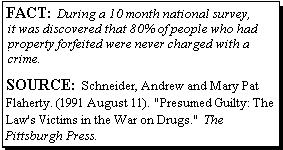 In 1997, the DEA seized $552 million in assets, and the US Customs Service seized $1.65
billion in
assets.
In 1997, the DEA seized $552 million in assets, and the US Customs Service seized $1.65
billion in
assets.
When forfeiture is employed as a civil penalty, the owner has no presumption of innocence, no right to an attorney, and unfounded hearsay may be used at trial by the government but not by the property owner.
123 This means that when there is insufficient evidence to make a criminal case against a defendant, the government can seize property and force the individual to challenge the civil-seizure in a costly and unpromising hearing.124 Since the burden of proof in these cases is reversed, it is up to the citizen to prove by a preponderance of the evidence that the property does not belong to the government.125Compounding the difficulties innocent property owners have in reclaiming their property is that when people are stripped of all their assets prior to trial, it is sometimes impossible to obtain legal counsel. There is no right to court-appointed counsel at the government's expense in forfeiture cases, and in “small” civil forfeitures – those where the property is worth less than $500,000 – the property owner must post a bond worth 10% of the value of the property in order to have the right to a court hearing.
126Forfeiture laws have changed the nature of law enforcement itself. Both crime prevention and due process goals of our criminal justice system are compromised when salaries, continued tenure, equipment, modernization and budget depend on how much money can be generated by forfeitures.
127 The Department of Justice occasionally places a higher priority on forfeiture than the prosecution of violent and property crimes. For instance, in 1989 all U.S. Attorneys were directed to divert resources to forfeiture efforts to meet their commitment “to increase forfeiture production,” suggesting they “divert personnel from other activities or …seek assistance from other U.S. Attorney's offices, the Criminal Division, and the Executive Office for United States Attorneys.”128
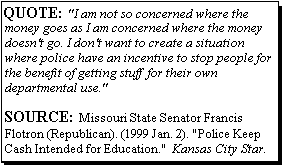 In an effort to prevent this type of conflict of interest, Missouri state law requires that
all seized assets be used to improve public education in the state. This removes the
temptation to abuse forfeiture powers and relieves taxpayers of the burden of education
costs. Unfortunately, police in that state have consistently thwarted attempts to implement
the law by giving seized assets to the DEA, which then returns the money to the police
agencies after retaining a 20% “processing fee.” In a 1999 five-part series,
the Kansas City Star investigated 14 cases of asset forfeiture where law enforcement
agencies seized $1.4 million and sent it to federal agencies, for return after paying
processing fees. In a 1998 ruling on such a case, the judge stated “By summoning the
DEA agent and then pretending DEA made the seizure, the DEA and Missouri Highway Patrol
successfully conspired to violate the Missouri Constitution,… the Missouri Revised
Codes, and a Missouri Supreme Court
decision.”
In an effort to prevent this type of conflict of interest, Missouri state law requires that
all seized assets be used to improve public education in the state. This removes the
temptation to abuse forfeiture powers and relieves taxpayers of the burden of education
costs. Unfortunately, police in that state have consistently thwarted attempts to implement
the law by giving seized assets to the DEA, which then returns the money to the police
agencies after retaining a 20% “processing fee.” In a 1999 five-part series,
the Kansas City Star investigated 14 cases of asset forfeiture where law enforcement
agencies seized $1.4 million and sent it to federal agencies, for return after paying
processing fees. In a 1998 ruling on such a case, the judge stated “By summoning the
DEA agent and then pretending DEA made the seizure, the DEA and Missouri Highway Patrol
successfully conspired to violate the Missouri Constitution,… the Missouri Revised
Codes, and a Missouri Supreme Court
decision.”
Recommendation 2: Restore voting rights to non-violent drug offenders and allow unhindered public referenda and initiatives.
An unanticipated side-effect of the War on Drugs has been the loss of voting rights on a massive scale, particularly among African-American men. According to a recent report by the Sentencing Project, 1.4 million or 13% of black men have lost the right to vote, which is seven times the national average (nationally about 2% of the population has lost the right to vote due to felony convictions). In seven states, 1 in 4 black men is permanently disenfranchised. The authors note, “In the late twentieth century, the [felony disenfranchisement laws] have no discernible legitimate purpose. Deprivation of the right to vote is not an inherent or necessary aspect of criminal punishment nor does it promote the reintegration of offenders into lawful society.”
130 The authors also note that, “An offender who receives probation for a single sale of drugs can face a lifetime of disenfranchisement. Restrictions on the franchise in the United States seem to be singularly unreasonable as well as racially discriminatory, in violation of democratic principles and international human rights law.”131Even those of us who have not been convicted of a crime, can find our constitutional right to vote curtailed because of the drug war. As citizens throughout the country are presented with ballot initiatives to allow medical access to marijuana, opponents of the concepts have sought to block citizens from even holding the vote. In Washington, DC, Congress barred the District government from expending any funds which would certify a law that reduces penalties for marijuana. District residents may vote, however, to increase penalties for marijuana. This means that for the first time in history, Congress has decided to control what types of elections can be held outside of the federal process and outlawed those votes which do not match the prevailing ideology of the Congress. At the time this document is being written, a lawsuit is pending in federal court on this very issue. Voters in Colorado and Arizona have faced similar obstacles, but Arizona voters have voted a second time in favor of medical marijuana and voters in Colorado have used the courts to force the election board to allow their initiative to proceed in 2000. The right of citizens to vote on any issue is the heart and soul of a democracy; any effort to derail that process subverts the will of the people and the spirit of our Constitution.
Recommendation 3: Restore civil liberties undermined by current drug policies.
Throughout the last two decades of the drug war, Congress and the courts have allowed a massive erosion of long-term, fundamental civil liberties. The warning of Justices William Brennan and Thurgood Marshall has come true: “…the first and worst casualty of the War on Drugs will be the precious liberties of our citizens.”
132As the United States moves to a public health-based drug control strategy it should restore constitutional protection for individual rights. Among the drug war decisions that need to be reconsidered by the courts or for which legislation is needed are those which:
These rights can be restored by legislation or court decisions which recognize that the Fourth Amendment
147 prohibits unreasonable searches – this means that searches of people or their property require either a search warrant or probable cause to believe a crime has been committed. If we develop a policy based on public health strategies there will no longer be a need for the intrusive police powers permitted in the last two decades of aggressive drug enforcement, nor the adversarial relationship between police and citizens.
118 HR 1835, Civil Asset Forfeiture Reform Act, was introduced by
Rep. Hyde (R-IL) and 29 co-sponsors (17 Dems., 12 Reps.) on June 10th,
1997.
119 Bureau of Justice Statistics, US Department of Justice.
Sourcebook of Criminal Justice Statistics, 1997. (1998), pp.
371-2.
120 Bennis v. Michigan, U.S. 116 S. Ct. 994 (1996).; United
States v. Ursery, 518 U.S. 267 (1996)
121 Bennis v. Michigan, U.S. 116 S. Ct. 994
(1996).
122 United States v. One Assortment of 89 Firearms, 465 U.S. 354,
361 (1984). United States v. Real Property Located at 6625 Zumirez
Drive, 845 F. Supp. 725, 733 (1994).
123 Argersinger v. Hamlin, 407 U.S. 25 (1972); 19 U.S. C. §
1615.
124 19 U.S.C. 1608 (1988). Also see "Win at All Costs: Government
Misconduct in the Name of Expedient Justice," Pittsburgh Post-Gazette,
(November - December 1998), Bill Moushey.
125 19 U.S.C. Sec. 1615.
126 Janzen, Sandra. (1992, January). Asset Forfeiture, Vol. 13
"Informants and Undercover Investigations." Bureau of Justice Statistics, U.S.
Department of Justice.
127 Blumenson, E. and E. Nilsen. (1998, Winter). "Policing for Profit:
The Drug War's Hidden Economic Agenda." University of Chicago Law
Review, vol. 65, pp. 35-114.
128 Directive #89-1. (1989, June 21). Memorandum from Acting Deputy
Attorney General Edward S. G. Dennis, Jr., to inter alia, All U.S. Attorneys,
contained in DOJ Asset Forfeiture Manual, V. 3. See also Directive 91-7.
(1991, May). Asset Forfeiture Talking Points.
129 Dillon, Karen. (1999, January 2). "Police Keep Cash Intended for
Education." Kansas City Star.
130 Jamie Fellner and Marc Mauer. (1998). Losing the Vote: The Impact
of Felony Disenfranchisement Laws in the United States. Human Rights Watch
(New York) and The Sentencing Project (Washington, DC), p. 1.
131 Ibid.
132 Skinner v. Railway Labor Executives Association, 489 U.S. 602
(1989).
133 Florida v. Royer, 460 U.S. 491 (1983); Florida v.
Rodriquez, 469 U.S. 1 (1984); United States v. Montoya de Hernandez,
473 U.S. 531 (1985).
134 United States v. Place, 426 U.S. 606 (1983).
135 Veronia School District v. Acton, 115 S. Ct. 2386
(1995).
136 United States v. Ross, 456 U.S. 798 (1982).
137 United States v. Knott, 460 U.S. 276 (1983).
138 Illinois v. Gates, 462 U.S. 213 (1983).
139 Oliver v. United States, 466 U.S. 170 (1984).
140 United States v. Dunn, 107 S.Ct. 1134 (1987).
141 California v. Ciraolo, 476 U.S. 207 (1986); Florida v. Riley,
488 U.S. 445 (1989)..
142 United States v. Miller, 425 U.S. 435 (1976).
143 Smith v. Maryland, 442 U.S. 735 (1979).
144 United States v. White, 401 U.S. 745 (1971).
145 California v. Greenwood, 486 U.S. 25 (1988).
146 Janzen, Sandra. (1992). Asset Forefeiture, Vol. 13,
"Informants and Undercover Investigations." Bureau of Justice Assistance, U.S.
Department of Justice.
147 The Fourth Amendment to the U.S. Constitution states:
[T]he right of the people to be secure in their persons, houses,
papers and effects, against unreasonable searches and seizures, shall not be
violated, and no Warrants shall issue, but upon probable cause, supported by
Oath or affirmation, and particularly describing the place to be searched or
things to be seized.