
OBJECTIVE: FIND A SOLUTION TO DRUG ABUSE THAT REALLY WORKS
 Rationale:
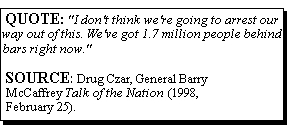
For years U.S. drug policy has taken the approach of arresting anyone who can be connected
with illegal drugs, and has gotten the same results – death, disease, violence and
increasing adolescent drug use. It is time for a critical review of drug policy, not annual
plans that promise more of the same. We need to recognize that the War on Drugs is a
simplistic, politically motivated approach to a complicated health and social phenomenon.
We need to develop a strategy based on more effective approaches.
Rationale:
For years U.S. drug policy has taken the approach of arresting anyone who can be connected
with illegal drugs, and has gotten the same results – death, disease, violence and
increasing adolescent drug use. It is time for a critical review of drug policy, not annual
plans that promise more of the same. We need to recognize that the War on Drugs is a
simplistic, politically motivated approach to a complicated health and social phenomenon.
We need to develop a strategy based on more effective approaches.
Recommendation 1: Commission a non-partisan panel of experts to evaluate America's longest war.9
 The War on Drugs is approaching a century in length, having been initiated in 1914
with the Harrison Narcotics Act. The drug war gets more expensive each year – the
1999 federal budget of $17.1 billion is a record and is several times larger than the
$3.6 billion appropriated in 1988. States and local governments spend an additional $20
billion annually.
The War on Drugs is approaching a century in length, having been initiated in 1914
with the Harrison Narcotics Act. The drug war gets more expensive each year – the
1999 federal budget of $17.1 billion is a record and is several times larger than the
$3.6 billion appropriated in 1988. States and local governments spend an additional $20
billion annually.
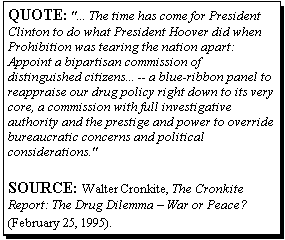
In order to develop a truly effective drug policy, a national commission should be empowered to analyze our approach and recommend new strategies. This commission should be led by an independent commission and all options should be considered for tobacco, alcohol and illegal drugs. ONDCP Director General McCaffrey recently said that legalization is a “legitimate cause for debate in a democracy.”
11 No doubt we need to consider whether criminal controls – relying on police, prosecutors and prisons – or legal controls – relying on regulation, taxation and administrative law – are more effective at controlling drug markets. However, in developing a more effective drug strategy we should remember that the vast majority of immediate policy options are not at the extremes of the debate, but rather involve moderate public health strategies and changes in budget priorities. This document represents a synthesis of centrist approaches to drug control.Recommendation 2: Allow cities and states to experiment with their own approach to drug control.
Cities and states have always been important sources of innovation and experimentation in public policy. Closer to their citizenry, city councils and state legislatures are often better qualified to identify solutions to problems which seem impossible at the national level. For instance, the city of Boston has been widely recognized for developing an effective strategy for reducing juvenile crime, and it recently had the distinction of being the only large American city to enjoy no juvenile homicides for more than two years.
12 The program was based on a mixture of community policing and providing at-risk youth with meaningful after-school activities.States and municipalities need greater flexibility from the federal government to address drug abuse as a public health issue. Federal drug policies that encourage states to adopt punitive approaches, including excessive penalties and limits to judicial discretion, are undermining productive state drug policy efforts. Federal drug policy must allow state and local governments the flexibility to develop new rational drug policies that emphasize education, economic opportunity, disease prevention, alternatives to incarceration and access to treatment and rehabilitation services, with some oversight to ensure that individual rights are not harmed in the process.
Recommendation 3: Make efforts at all levels of government to separate the markets for marijuana from other illegal drugs.
According to a recent report by the World Health Organization (WHO), the hypothesis that adolescent use of hard drugs is a direct effect of marijuana use is the “least compelling of all hypotheses.” The WHO report suggests that the current prohibition on marijuana may do more to introduce children to hard drugs than any other cause, stating, “Exposure to other drugs when purchasing cannabis on the black market increases the opportunity to use other illicit drugs.”
13 This finding has important implications for public policy, and suggests that if we want to reduce heroin and cocaine use, we can move closer to that goal by separating the marijuana market from the market for harder drugs. The Netherlands is the only nation which has implemented such a policy, so it is important to note that even though marijuana is widely available, the Netherlands' heroin use rate is 160 users per 100,000 population,14 while the United States is estimated to have 430 heroin users per 100,000 population.15 Thus, when comparing the experience of the two countries, it appears the World Health Organization's hypothesis that the black market in marijuana increases the opportunity to use other drugs has some merit and also reinforces the hypothesis that marijuana can act as a terminus drug, rather than a gateway. The reality is, for every 104 Americans who have used marijuana, there is only one regular user of cocaine, and less than one regular user of heroin.16By promoting an absolutist “zero-tolerance” policy for all substances regardless of relative dangers and by accepting the 'gateway' myth, we may actually expose those youths and young adults who would briefly experiment with a soft drug like marijuana to more dangerous substances like cocaine and heroin. A public policy that is blind to the reality of drug markets effectively abandons youth who experiment with marijuana – the most widely used illicit drug. This is a tragic example of how ideology and adherence to failed policy can prevent our society from making progress in reducing drug use.
| A Brief Chronology of Independent Drug Policy Reports |
|---|
|
9 On April 16th, 1997, Rep. Cummings (D-MD) with 19 democratic
cosponsors introduced H.R. 1345 a bill to create a Commission on National
Drug Policy.
10 Drucker, Dr. Ernest. (1998, Jan./Feb.). Public Health Reports,
"Drug Prohibition and Public Health." U.S. Public Health Service. Vol. 114,
p. 17.
11 On December 3, 1998 when a caller to CSPAN's Washington
Journal asked about legal access to marijuana General McCaffrey said: "...
I think it's a legitimate cause for debate in a democracy. The country ought to
do whatever it thinks is appropriate. Many of us are uncomfortable with the
idea of more psychoactive drugs. We're opposed to it and that's a viewpoint I
couldn't express more strongly..."
12 Associated Press. (3 March 1998). "Kennedy Proposes Crime Program."
Washington, DC: Associated Press.
13 Hall, W., Room, R. and Bondy, S. (1998, March). WHO Project on
Health Implications of Cannabis Use: A Comparative Appraisal of the Health and
Psychological Consequences of Alcohol, Cannabis, Nicotine and Opiate Use,
August 28, 1995.
14 Dutch Ministry of Health, Welfare and Sport [VMS]. (1995). Drug
Policy in the Netherlands: Continuity and Change. The
Netherlands.
15 Abt. & Associates, Inc. (1997, September 29). What America's
Users Spend on Illegal Drugs, 1988-1995. Commissioned by the White House
ONDCP; U.S. Bureau of the Census. (1996). Statistical Abstract of the United
States: 1996 (116th Edition). Washington, DC.
16 Substance Abuse and Mental Health Administration, National
Household Survey on Drug Abuse: Population Estimates 1997, Rockville, MD:
Substance Abuse and Mental Health Administration (1998, July), pp. 23, 103, 113
[a regular user is someone who used a drug 51 or more days in the past
year].